
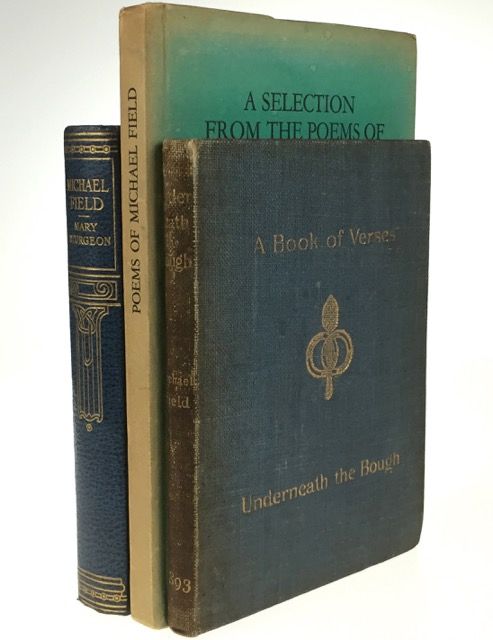
The ‘Third Book of Songs’ shares corresponding themes of monism, naturalism and pantheism with the other numbered ‘Books’ in Underneath the Bough. Plentiful fauns, bees, birds and Hellenic characters surface and then vanish throughout stanzas. In the ‘Third Book of Songs’ we are harkened back to ancient Greece and consumed by a temporal reverie, where the orderly Apollo and his arty Muses are unable to, for all their wisdom, appear to warn the narrator of a coming change in ‘When high Zeus first peopled earth’. This change, we can infer, is that of love. And love it seems is an unpredictable force that even the gods and their disciples cannot predict nor master.
“When high Zeus first peopled earth
Methinks my love to thee doth grow
Though must not leave me
It was deep April and the morn
Apollo and the Muses taught thee not
There comes a change in her breath
A girl
Our myrtle is in flower
Have you seen the olives at set of sun
She lies asleep: I watching do not dare
O sweet, all sweet, the body as the shyer
Mine is the eddying foam and the broken current
Sweet of my poet how sweet are the eyes, the eyelids
Though I sing high and chaunt above her
Shall there ever be a morn
I love her with the seasons, with the winds”
But something more than love is amiss in this first poem, which begins to resonate throughout ensuing poems. The “nurslings” are “Helpless” and “age” is plagued by mentions of “death”. This is all too soon accompanied by the mention of “Childhood” and “generations” as if this death and disaster will continue to “sing” throughout the narrator’s life. The narrator feels like a “broken current”, ravaged by confusion and no more than an “eddying foam” never quite able to settle for one path, one “current”. It seems the author Michael Field is dwelling on negative tidings.
“In eld’s weak palm found providence,
And each through influence
Of things beholden and not borne grew mild”
The above quotation implies that the narrator is disillusioned with providence by the influence of others and things seen and learned over time. Due to things “beholden” and things learned that were not “borne” before, providence loses its “influence” with the narrator’s increasing age – “In eld’s weak palm” – which paints a dreary picture.
Though a different stanza, the next one clearly identifies that this poem concerns the Fields themselves:
“Dear, had not the story’s truth
Most manifest?
Had our lives been twinned, forsooth,
We had never had one heart
…
We are bound by such close ties
None can tell of either breast”
The Fields, it seems, are in conflict with their inner selves, or perhaps their joined inner identity of ‘Michael Field’. Normally readers are unable to tell their words apart – “None can tell of either breast” – as such is the uniquely close nature of their bond, but this may no longer be the case. There now exists a fracture in their literary ‘oneness’.
This poetry comes after the absence of Bernard Berenson in their lives and emergence of a fascination with Catholicism, so the melancholy and confusion is understandable. Readers who choose to decode this poem as an insight into the Fields’ personal lives may choose to believe that this signals a shift in their spiritual beliefs. Poems become a desire for transcendence and creative stimulus, a need for answers to ‘art’ and ‘beauty’ and thus their respective aesthetic paths. Of course the Fields remain close, but Bradley and Cooper are undergoing alternative philosophical outlooks on aesthetics and spiritualism, looking for their “story’s truth”. They do not seem to know “with whom the Muse is guest” out of the two of them and therefore struggle to find poetic inspiration.
Implementing their signature synaesthesia, the poem quickly turns to the senses and self-reflection. “To see and smell the rose of my own youth” is a desire to revisit the past, perhaps of Berenson or of times of more aesthetic clarity. The same pessimism that haunts the first stanza returns in the next, for “gathering waters” creates tears of “grief” and the Fields outline a recent “Farewell” made. This good bye was necessary, and though further cements the Fields as one – “we must dwell together” – is bittersweet and difficult. It is not a literal parting – the language of the Fields is often veiled and careful – but rather the poem represents an emotional detachment, or spiritual “sever”.
Either way, this poem sets the tone for the subsequent ones in the ‘Third Book of Songs’, which feature a “tempestuous heart” and search for where “God art found”, a “disbodied sprite” and insecurities of feeling only “half poet and half child”. There is a “rent heart” and a “mournful land”, a “flute” sung with “distress” and other subtle nihilistic cynicisms. Titles such as ‘If I but dream that thou art gone’ and ‘There comes a change in her breath’ betray slight disturbances in the thoughts of ‘Michael Field’.
If we treat the ‘Third Book of Songs’ as a chapter in the Fields’ lives as much as a part of the story told throughout Underneath the Bough, then we can see this all-consuming change come full circle by the ‘Fifth Book of Songs’. Dionysus (or “Bacchus” as this collection refers to him) watches over this change, his “glazing eyes” and “athirst” for something in ‘A land of riotous harvest and of sweat’ resounding the Fields’ quest for something. In ‘Full summer and at noon; my waste-bed’ it is declared that “None shares my vision!” and even “fern and flower are blind”. All seems futile and even nature and the world itself cannot see what the storytellers of the poems do. There is no creativity, no inspiration to be found. ‘Michael Field’ is left with but one thing to do: he must renew himself, as the “young phoenix” does in ‘As the young phoenix, duteous to his sire’:
“So joyously I lift myself above
The life I buried in hot flames to-day ;
The flames themselves are dead — and I can range
Alone through the untarnished sky I love,
And trust myself, as from the grave one may,
To the enchanting miracles of change.”
The Fields, then, recognise that they must move ahead and without dwelling on the ‘old’ they have created. Change is inevitable but not necessarily damning. If one can “trust myself” then there can be “miracles of change” – brighter, better, progressive change.
 Exploring Michael Field