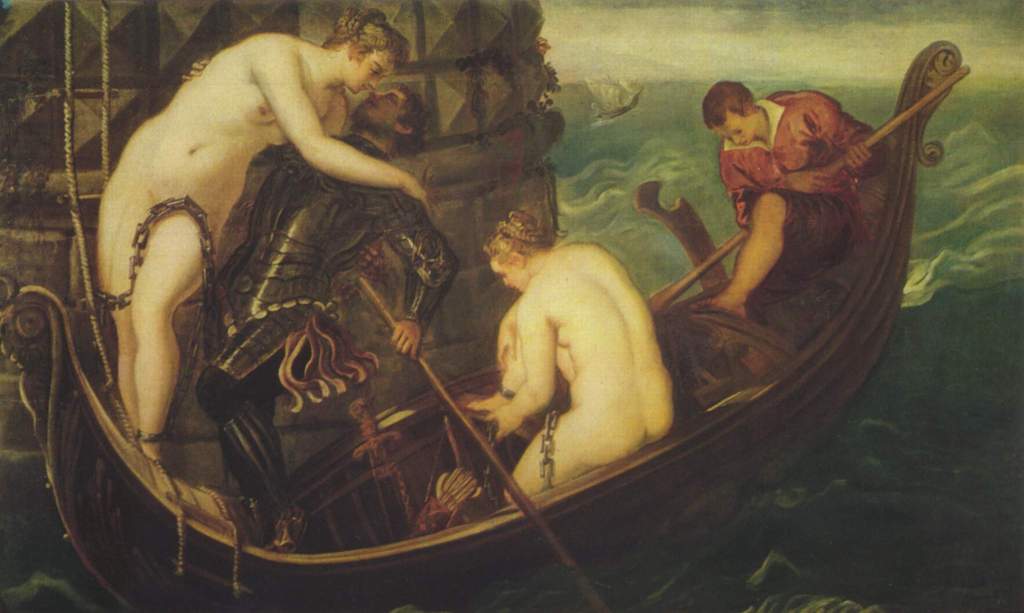
‘The Rescue’

Jacopo Robusti, 
called Tintoretto,
‘The Rescue of Arsinoe’, circa 1556


GREY tower, green sea, dark armour and clear curves
Of shining flesh ; the tower built far into the sea
And the dark armour that of one coming to set her free
Who, white against the chamfered base,
From fetters that her noble limbs enlace
Bows to confer
Herself on her deliverer :
He, dazzled by the splendid gift,
Steadies himself against his oar, ere he is strong to lift
And strain her to his breast :
Her powerful arms lie in such heavy rest
Across his shoulder, though he swerves
And staggers with her weight, though the wave buoys,
Then slants the vessel, she maintains his form in poise.
Her sister-captive, seated on the side
Of the swayed gondola, her arched, broad back in strain,
Strikes her right ankle, eager to discumber it of chain,
Intent upon her work, as though
It were full liberty ungyved to go.
She will not halt,
But spring delighted to the salt,
When fetterless her ample form
Can beat the refluence of the waves back to their crested storm.
Has she indeed caught sight
Of that blithe tossing pinnace on the white
Scum of the full, up-bearing tide?
The rose-frocked rower-boy, in absent fit
Or modesty, surveys his toe and smiles at it.
Her bondage irks not ; she has very truth
Of freedom who within her lover’s face can seek
For answer to her eyes, her breath, the blood within her cheek—
A soul so resolute to bless
She has forgot her shining nakedness
And to her peer
Presents immunity from fear :
As one half-overcome, half-braced,
The man’s hand searches as he grips her undulating waist :
So these pure twain espouse
And without ravishment, mistrust, or vows
Of constancy fulfil their youth ;
In the rough niches of the wall behind
Their meeting heads, how close the trails of ivy wind ! 

accessed via ‘The Poems of Michael Field’


Tintoretto’s piece pictures Arsinoe as she flees from Egypt after Julius Cesar takes over to side with her sister Cleopatra.

Points of interest

  • Inversion of fairytales and legends
    In their mockery of the heterosexual male who generally embraces his rescued heroine in the majority of stories and legends, the Fields narrate Arsinoe instead hefting her immovable arms “in heavy rest” upon the gentleman’s shoulders, towering over him with the height of a goddess, bowing to confer herself “on her deliverer”, causing him to “stagger”with her weight. In “modesty” the sailor boy looks to his foot to avert his gaze – a further implementation of humour, no doubt.
  • Alternative “sister-captive” viewing
    The “chains” and “bondage” the “sister-captive” experiences is contrasted by a contentment to be “fettered” by her female peer who is too busy looking into the eyes of her rescuer, “delighted”. Here, the act of gazing is able to influence feeling: this echoes the overall message of Sight and Song.
  • Synaesthesiac conciousness
    We experience the visual in the form of colours and actions – “Grey”,“green”, “dark”, “Strikes” and “white” – but also witness the sounds of the waves and their “refluence” as well as the “storm”, a sister-captive’s “breath” and an “up-bearing tide”. Then there is the kinaesthetic “irks”, “A soul so resolute”, a captive’s “strain”, and the grasping of “truth”. These sights, sounds and feelings combine to create a living, breathing, thriving scene that is no longer a poem echoing a still image. We are immersed within the narrative so that we as readers experience synaesthetic conciousness and thus are assimilated mind and body into the historical event.
  • Objective and subjective binaries
    The “arched back” and illuminated “curves” of the subjective female bodies described in this poem also mirror the architecture of the cylindrical tower and the swirling, tidal waves lapping in on themselves as we revert back to objective viewing. It is as if we have come full circle in reading this poem, having toured not just the chaos of the nature at work in this historical verisimilitude but the patterns of passion undulating between the lovers and the rest of the party.
  • Literary symbolism
    “Ivy” noticeably snakes up the tower that they pass and this is noted in the poem. This is a homage to Dionysus, the mad god, for in Greco-Roman tradition ivy supposedly clings and coils around objects in a similar manner to the way passions and emotions cause individuals to cling to others [1]. This evidently mimics the behaviour of the lovers depicted in the painting.

Footnotes

[1] See A Dictionary of Literary Symbols, (Cambridge University Press: Cambridge, 2007), Credo Reference, 10.

‘La Gioconda’

‘La Gionconda’ or the ‘Mona Lisa’
by Leonardo da Vinci, 1503-1506


HISTORIC, side-long, implicating eyes ;
A smile of velvet’s lustre on the cheek ;
Calm lips the smile leads upward ; hand that lies
Glowing and soft, the patience in its rest
Of cruelty that waits and doth not seek
For prey ; a dusky forehead and a breast
Where twilight touches ripeness amorously :
Behind her, crystal rocks, a sea and skies
Of evanescent blue on cloud and creek ;
Landscape that shines suppressive of its zest
For those vicissitudes by which men die. 

accessed via ‘The Poems of Michael Field’


Arguably the most famous painting in the world (and likely still the most famous back in the Fields’ day), the ‘Mona Lisa’ or ‘La Gioconda’ is a portrait painted by Italian renaissance artist Leonardo da Vinci. The painting has been the source of much speculation and imaginative theories for writers of all stripes and notably possesses a strong resemblance to Renaissance era portrayals of the Virgin Mary. This would not have escaped the Fields’ attention – particularly as later Roman Catholics – but there is something more noteworthy about the painting’s inclusion within Sight and Song. As a poetry collection which tackles vision and visuality, ‘La Gioconda’ holds a special place in the collection: as Professor Margaret Livingstone of Harvard University has pointed out, the lady’s smile vanishes when observed directly. This process is part of what is known as ‘foveal‘. The human eye does not identify shadows directly in its visual process, while peripheral vision does. This creates a somewhat illusionary smile – visual trickery. Perhaps the Fields experienced some of this visual trickery when inspecting ‘La Gionconda’.

Points of interest

  • Alternating perspectives
    The poem can be split into two halves. There is a subjective overview of the “cheek” and “calm lips”, the Mona Lisa “glowing” with a sly kind of “cruelty” manifesting in her devious smile playing upon Victorian visions of wildly untamed femme fatalewomen who “prey” upon unsuspecting subjects (see Linton’s essay on “Wild Women”[1]). Then we defer to the objective mountainous terrain attempting to enclose and tame her, the distant “crystal rocks” overlooking a landscape “suppressive” and all-consuming, as precarious as the lady herself with its ability to crush men – “vicissitudes by which men die”.
  • Re-writing a narrative
    But yet the dangerous landscape somehow pales in comparison to the lady we are greeted with courtesy of the Fields’ ekphrastic picture they have re-painted for us with words. The Fields plant seeds of corruption and secretive intent; they interlace the narrative with gems for us to detect and suddenly acknowledge anew. In their own way, they are remaking the original narrative Da Vinci painted for us. The painting becomes a dark story and the lady’s intentions become questionable.
  • Opposing binaries
    The poem is at war within itself: the Mona Lisa not only waits, eerily, to deploy her “cruelty” which contradicts her “soft” and “calm” nature, but the lashing of “sea and skies” fights to “suppress” the “zest” and therefore beauty of “cloud and creek”. Colours of day and night seem to juxtapose: “dusk” and “twilight” is contrasted by “blue” which creates a fluctuating palette.
  • Veiled language
    That is to say nothing of the “implicating eyes” which seem to infer that we, the onlookers, are guilty of something – perhaps of simply seeing – and this evokes amusement from her, a “smile” which works in conjunction with a “hand that lies” seemingly in wait to do something. Is this sexual tension? Mere observation? Her apparent “cruelty” is marked by a “dusky forehead and a breast” – is she guilty of terrible thoughts in that head as well as bodily sins involving that breast? The structuring of certain corporeal elements one after the other seems purposeful. The Fields dance delicately with words, never outwardly stating the lady’s intentions but never denying possibilities, either.
  • A daughter of decadence
    This lady becomes a spidery femme fatale, and her gaze is a web that ensnares us: this poem also warns the reader of the dangers of interpreting from seeing. We are not only seeing visually, but also psychologically: the subjective first half of the poem evidences this. There is undoubtedly something objectively “Historic” about her, but she also straddes then-modern beliefs in the 1880s onwards regarding decadent, sexually degenerate women harbouring precarious intentions.

Footnotes

[1] Eliza Lynn Linton, Nineteenth Century 30, No. 176 (October 1891): 596—605.