
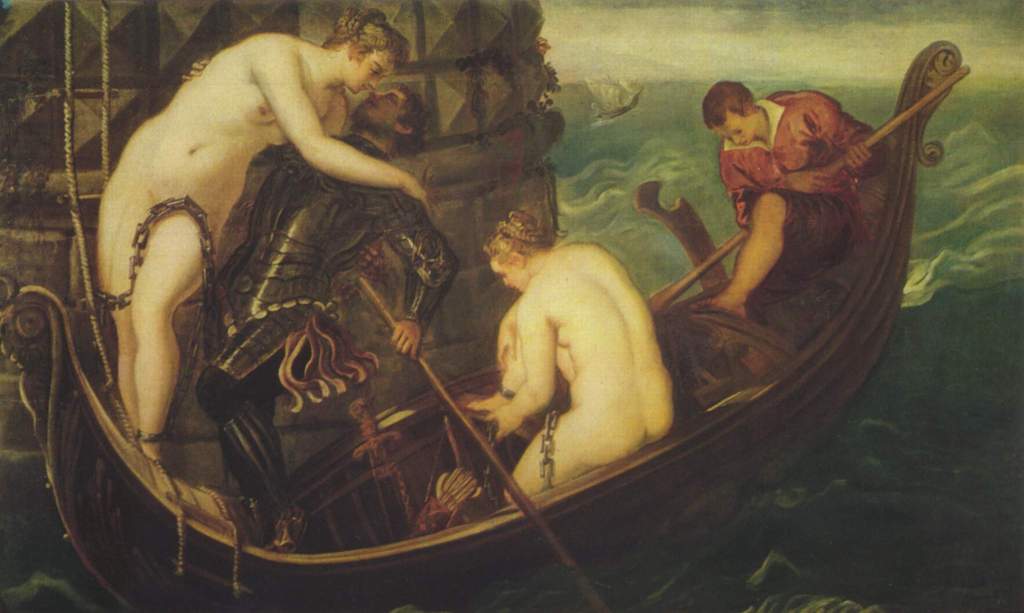
Jacopo Robusti,
called Tintoretto,
‘The Rescue of Arsinoe’, circa 1556
GREY tower, green sea, dark armour and clear curves
Of shining flesh ; the tower built far into the sea
And the dark armour that of one coming to set her free
Who, white against the chamfered base,
From fetters that her noble limbs enlace
Bows to confer
Herself on her deliverer :
He, dazzled by the splendid gift,
Steadies himself against his oar, ere he is strong to lift
And strain her to his breast :
Her powerful arms lie in such heavy rest
Across his shoulder, though he swerves
And staggers with her weight, though the wave buoys,
Then slants the vessel, she maintains his form in poise.
Her sister-captive, seated on the side
Of the swayed gondola, her arched, broad back in strain,
Strikes her right ankle, eager to discumber it of chain,
Intent upon her work, as though
It were full liberty ungyved to go.
She will not halt,
But spring delighted to the salt,
When fetterless her ample form
Can beat the refluence of the waves back to their crested storm.
Has she indeed caught sight
Of that blithe tossing pinnace on the white
Scum of the full, up-bearing tide?
The rose-frocked rower-boy, in absent fit
Or modesty, surveys his toe and smiles at it.
Her bondage irks not ; she has very truth
Of freedom who within her lover’s face can seek
For answer to her eyes, her breath, the blood within her cheek—
A soul so resolute to bless
She has forgot her shining nakedness
And to her peer
Presents immunity from fear :
As one half-overcome, half-braced,
The man’s hand searches as he grips her undulating waist :
So these pure twain espouse
And without ravishment, mistrust, or vows
Of constancy fulfil their youth ;
In the rough niches of the wall behind
Their meeting heads, how close the trails of ivy wind !
accessed via ‘The Poems of Michael Field’
Tintoretto’s piece pictures Arsinoe as she flees from Egypt after Julius Cesar takes over to side with her sister Cleopatra.
Points of interest
- Inversion of fairytales and legends
In their mockery of the heterosexual male who generally embraces his rescued heroine in the majority of stories and legends, the Fields narrate Arsinoe instead hefting her immovable arms “in heavy rest” upon the gentleman’s shoulders, towering over him with the height of a goddess, bowing to confer herself “on her deliverer”, causing him to “stagger”with her weight. In “modesty” the sailor boy looks to his foot to avert his gaze – a further implementation of humour, no doubt. - Alternative “sister-captive” viewing
The “chains” and “bondage” the “sister-captive” experiences is contrasted by a contentment to be “fettered” by her female peer who is too busy looking into the eyes of her rescuer, “delighted”. Here, the act of gazing is able to influence feeling: this echoes the overall message of Sight and Song. - Synaesthesiac conciousness
We experience the visual in the form of colours and actions – “Grey”,“green”, “dark”, “Strikes” and “white” – but also witness the sounds of the waves and their “refluence” as well as the “storm”, a sister-captive’s “breath” and an “up-bearing tide”. Then there is the kinaesthetic “irks”, “A soul so resolute”, a captive’s “strain”, and the grasping of “truth”. These sights, sounds and feelings combine to create a living, breathing, thriving scene that is no longer a poem echoing a still image. We are immersed within the narrative so that we as readers experience synaesthetic conciousness and thus are assimilated mind and body into the historical event. - Objective and subjective binaries
The “arched back” and illuminated “curves” of the subjective female bodies described in this poem also mirror the architecture of the cylindrical tower and the swirling, tidal waves lapping in on themselves as we revert back to objective viewing. It is as if we have come full circle in reading this poem, having toured not just the chaos of the nature at work in this historical verisimilitude but the patterns of passion undulating between the lovers and the rest of the party. - Literary symbolism
“Ivy” noticeably snakes up the tower that they pass and this is noted in the poem. This is a homage to Dionysus, the mad god, for in Greco-Roman tradition ivy supposedly clings and coils around objects in a similar manner to the way passions and emotions cause individuals to cling to others [1]. This evidently mimics the behaviour of the lovers depicted in the painting.
Footnotes
[1] See A Dictionary of Literary Symbols, (Cambridge University Press: Cambridge, 2007), Credo Reference, 10.

 Exploring Michael Field