‘La Gioconda’

‘La Gionconda’ or the ‘Mona Lisa’
by Leonardo da Vinci, 1503-1506


HISTORIC, side-long, implicating eyes ;
A smile of velvet’s lustre on the cheek ;
Calm lips the smile leads upward ; hand that lies
Glowing and soft, the patience in its rest
Of cruelty that waits and doth not seek
For prey ; a dusky forehead and a breast
Where twilight touches ripeness amorously :
Behind her, crystal rocks, a sea and skies
Of evanescent blue on cloud and creek ;
Landscape that shines suppressive of its zest
For those vicissitudes by which men die. 

accessed via ‘The Poems of Michael Field’


Arguably the most famous painting in the world (and likely still the most famous back in the Fields’ day), the ‘Mona Lisa’ or ‘La Gioconda’ is a portrait painted by Italian renaissance artist Leonardo da Vinci. The painting has been the source of much speculation and imaginative theories for writers of all stripes and notably possesses a strong resemblance to Renaissance era portrayals of the Virgin Mary. This would not have escaped the Fields’ attention – particularly as later Roman Catholics – but there is something more noteworthy about the painting’s inclusion within Sight and Song. As a poetry collection which tackles vision and visuality, ‘La Gioconda’ holds a special place in the collection: as Professor Margaret Livingstone of Harvard University has pointed out, the lady’s smile vanishes when observed directly. This process is part of what is known as ‘foveal‘. The human eye does not identify shadows directly in its visual process, while peripheral vision does. This creates a somewhat illusionary smile – visual trickery. Perhaps the Fields experienced some of this visual trickery when inspecting ‘La Gionconda’.

Points of interest

  • Alternating perspectives
    The poem can be split into two halves. There is a subjective overview of the “cheek” and “calm lips”, the Mona Lisa “glowing” with a sly kind of “cruelty” manifesting in her devious smile playing upon Victorian visions of wildly untamed femme fatalewomen who “prey” upon unsuspecting subjects (see Linton’s essay on “Wild Women”[1]). Then we defer to the objective mountainous terrain attempting to enclose and tame her, the distant “crystal rocks” overlooking a landscape “suppressive” and all-consuming, as precarious as the lady herself with its ability to crush men – “vicissitudes by which men die”.
  • Re-writing a narrative
    But yet the dangerous landscape somehow pales in comparison to the lady we are greeted with courtesy of the Fields’ ekphrastic picture they have re-painted for us with words. The Fields plant seeds of corruption and secretive intent; they interlace the narrative with gems for us to detect and suddenly acknowledge anew. In their own way, they are remaking the original narrative Da Vinci painted for us. The painting becomes a dark story and the lady’s intentions become questionable.
  • Opposing binaries
    The poem is at war within itself: the Mona Lisa not only waits, eerily, to deploy her “cruelty” which contradicts her “soft” and “calm” nature, but the lashing of “sea and skies” fights to “suppress” the “zest” and therefore beauty of “cloud and creek”. Colours of day and night seem to juxtapose: “dusk” and “twilight” is contrasted by “blue” which creates a fluctuating palette.
  • Veiled language
    That is to say nothing of the “implicating eyes” which seem to infer that we, the onlookers, are guilty of something – perhaps of simply seeing – and this evokes amusement from her, a “smile” which works in conjunction with a “hand that lies” seemingly in wait to do something. Is this sexual tension? Mere observation? Her apparent “cruelty” is marked by a “dusky forehead and a breast” – is she guilty of terrible thoughts in that head as well as bodily sins involving that breast? The structuring of certain corporeal elements one after the other seems purposeful. The Fields dance delicately with words, never outwardly stating the lady’s intentions but never denying possibilities, either.
  • A daughter of decadence
    This lady becomes a spidery femme fatale, and her gaze is a web that ensnares us: this poem also warns the reader of the dangers of interpreting from seeing. We are not only seeing visually, but also psychologically: the subjective first half of the poem evidences this. There is undoubtedly something objectively “Historic” about her, but she also straddes then-modern beliefs in the 1880s onwards regarding decadent, sexually degenerate women harbouring precarious intentions.

Footnotes

[1] Eliza Lynn Linton, Nineteenth Century 30, No. 176 (October 1891): 596—605.
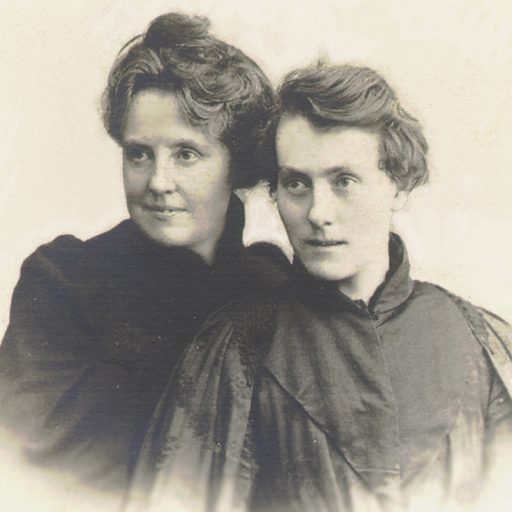
Introducing the Fields

The pseudonym of Michael Field was operated by two female poets, lovers and aesthetes named Katherine Bradley and Edith Cooper. When their true identities were discovered, they were often referred to as the “Fields” or the “Michaels”.

Cooper was the niece and ward of Bradley, moving in with her aunt in the late 1870s. This was because her mother, Emma Cooper, who played an integral role in shaping the life of her younger sister Katherine, became somewhat of an invalid after the birth of her second daughter. Katherine offered to become legal guardian of her niece and thus began a later lesbian relationship and co-authorship over the next forty years.

Edith Cooper wrote poetry by the age of ten, apparently translated Virgil by her early teens, and enjoyed using obscure philosophical concepts to test her elders’ knowledge. Her aunt Bradley recognised a part of herself in her and referred to Edith as inheriting the “Bradley force”, unlike her sister Amy, who Katherine never quite connected with on the same level as she had Edith.

Though born in Birmingham, Katherine’s family came from Derbyshire ancestors who settled in Ashbourne. Business ran in the blood, for Katherine and Emma’s father, Charles Bradley, worked within the tobacco industry in Birmingham and left a stream of profits which allowed for Edith Cooper and Katherine Bradley’s later financial independence.

1 The Paragon, Richmond, London where the Fields later resided to be closer to their friends Ricketts and Shannon

This also left room for a rather lavish lifestyle, and the Fields became staunch aestheticists and connoisseurs of art, music and poetry, regarded as highly educated and cultured individuals. Bradley and Cooper were also followers of Walter Pater. They travelled extensively to continental galleries and exhibitions, read from classical to Renaissance works, and drifted among numerous literary circles. Among many others, they became known to Oscar Wilde, Elkin Matthews, Alice Meynell, Vernon Lee, and even John RuskinRobert Browning and William Rothstein were close friends, and in particular the Fields fostered a unique bond with painters and partners Charles Rickettsand Charles Shannon.

The Fields were known to develop fond nicknames for their friends. Among such nicknames were the “old Gentleman” for Robert Browning himself, “Painter” for Charles Ricketts, “Doctrine” for Bernard Berenson and “The Roadman” for publisher John Lane. Even their fellow canine companion Whym Chow, one of many pets but beyond doubt their most beloved, was often shortened to “Whymmie”. Their adoration for Whym was so strong that fourteen years after the Chow passed away in 1914, they even dedicated a poetry collection to their dear friend, entitled “Whym Chow: The Flame of Love”. The loss of Whym also disturbed their writing for a time, the women plagued by grief.

Katherine Bradley with Whym Chow, circa 1914

The Fields were also married, though refrained from shocking family and friends with this information, instead reserving such a status as something to be used solely in their private letters to one another. But they were not married in the literal, ceremonial sense: they kept their finances separate and had no children. Marriage for Katherine Bradley and Edith Cooper was more of a metaphor for their unique kind of bond – they lived rather a wedded lifestyle, would always love each other yet develop crushes on other men and women (as they did for Bernard Berenson), and always present a united front despite any conflicts, regarding themselves as untiring, godlike lovers rather than loyal spouses.

Indeed, the nature of the Fields’ relationship calls into question the values we associate with marriage in the late 1800s when compared with marriage in the present, and lesbian homosexuality in particular [1]. Their relationship was something else entirely. As their operation of the title ‘Michael Field’ suggests, their relationship was of a special unanimity, a shared oneness which perhaps illustrates their own version of ‘marriage’ – they were connected in mind as much as they were in proximity. Only together could they be ‘Michael Field’. This is likely why even after Robert Browning revealed their co-authorship, Bradley and Cooper still insisted upon being seen as one male author. ‘Michael Field’ was not just an interplay between male, female and Sapphic identities but also a homage to their oneness, a symbol of their devoted literary, cultural and personal union.


Footnotes

[1] See Kate Flint, “Unspeakable Desires: We Other Victorians,” in The Oxford Handbook of Victorian Literary Culture, (Oxford University Press: Oxford, 2016), 205.