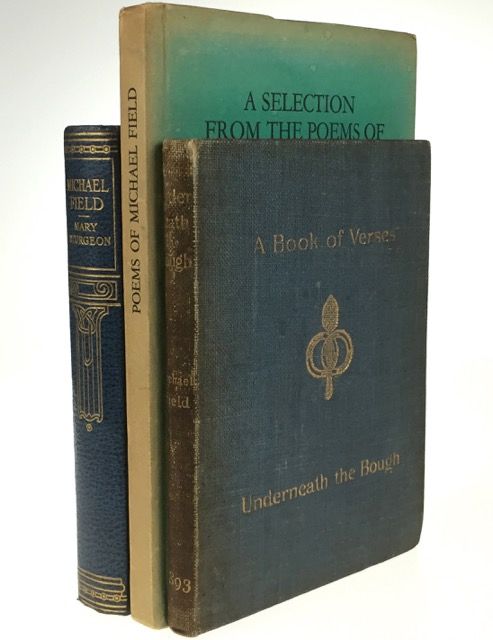
A Darker Chapter in the Fields’ Lives: ‘Underneath the Bough’

The ‘Third Book of Songs’ shares corresponding themes of monism, naturalism and pantheism with the other numbered ‘Books’ in Underneath the Bough. Plentiful fauns, bees, birds and Hellenic characters surface and then vanish throughout stanzas. In the ‘Third Book of Songs’ we are harkened back to ancient Greece and consumed by a temporal reverie, where the orderly Apollo and his arty Muses are unable to, for all their wisdom, appear to warn the narrator of a coming change in ‘When high Zeus first peopled earth’. This change, we can infer, is that of love. And love it seems is an unpredictable force that even the gods and their disciples cannot predict nor master.

“When high Zeus first peopled earth

Methinks my love to thee doth grow

Though must not leave me

It was deep April and the morn

Apollo and the Muses taught thee not

There comes a change in her breath

A girl

Our myrtle is in flower

Have you seen the olives at set of sun

She lies asleep: I watching do not dare

O sweet, all sweet, the body as the shyer

Mine is the eddying foam and the broken current

Sweet of my poet how sweet are the eyes, the eyelids

Though I sing high and chaunt above her

Shall there ever be a morn

I love her with the seasons, with the winds”

But something more than love is amiss in this first poem, which begins to resonate throughout ensuing poems. The “nurslings” are “Helpless” and “age” is plagued by mentions of “death”. This is all too soon accompanied by the mention of “Childhood” and “generations” as if this death and disaster will continue to “sing” throughout the narrator’s life. The narrator feels like a “broken current”, ravaged by confusion and no more than an “eddying foam” never quite able to settle for one path, one “current”. It seems the author Michael Field is dwelling on negative tidings.

“In eld’s weak palm found providence,

And each through influence

Of things beholden and not borne grew mild”

The above quotation implies that the narrator is disillusioned with providence by the influence of others and things seen and learned over time. Due to things “beholden” and things learned that were not “borne” before, providence loses its “influence” with the narrator’s increasing age – “In eld’s weak palm” – which paints a dreary picture.

Though a different stanza, the next one clearly identifies that this poem concerns the Fields themselves:

“Dear, had not the story’s truth

Most manifest?

Had our lives been twinned, forsooth,

We had never had one heart

We are bound by such close ties

None can tell of either breast”

The Fields, it seems, are in conflict with their inner selves, or perhaps their joined inner identity of ‘Michael Field’. Normally readers are unable to tell their words apart – “None can tell of either breast” – as such is the uniquely close nature of their bond, but this may no longer be the case. There now exists a fracture in their literary ‘oneness’.

This poetry comes after the absence of Bernard Berenson in their lives and emergence of a fascination with Catholicism, so the melancholy and confusion is understandable. Readers who choose to decode this poem as an insight into the Fields’ personal lives may choose to believe that this signals a shift in their spiritual beliefs. Poems become a desire for transcendence and creative stimulus, a need for answers to ‘art’ and ‘beauty’ and thus their respective aesthetic paths. Of course the Fields remain close, but Bradley and Cooper are undergoing alternative philosophical outlooks on aesthetics and spiritualism, looking for their “story’s truth”. They do not seem to know “with whom the Muse is guest” out of the two of them and therefore struggle to find poetic inspiration.

Implementing their signature synaesthesia, the poem quickly turns to the senses and self-reflection. “To see and smell the rose of my own youth” is a desire to revisit the past, perhaps of Berenson or of times of more aesthetic clarity. The same pessimism that haunts the first stanza returns in the next, for “gathering waters” creates tears of “grief” and the Fields outline a recent “Farewell” made. This good bye was necessary, and though further cements the Fields as one – “we must dwell together” – is bittersweet and difficult. It is not a literal parting – the language of the Fields is often veiled and careful – but rather the poem represents an emotional detachment, or spiritual “sever”.

Either way, this poem sets the tone for the subsequent ones in the ‘Third Book of Songs’, which feature a “tempestuous heart” and search for where “God art found”, a “disbodied sprite” and insecurities of feeling only “half poet and half child”. There is a “rent heart” and a “mournful land”, a “flute” sung with “distress” and other subtle nihilistic cynicisms. Titles such as ‘If I but dream that thou art gone’ and ‘There comes a change in her breath’ betray slight disturbances in the thoughts of ‘Michael Field’.

If we treat the ‘Third Book of Songs’ as a chapter in the Fields’ lives as much as a part of the story told throughout Underneath the Bough, then we can see this all-consuming change come full circle by the ‘Fifth Book of Songs’. Dionysus (or “Bacchus” as this collection refers to him) watches over this change, his “glazing eyes” and “athirst” for something in ‘A land of riotous harvest and of sweat’ resounding the Fields’ quest for something. In ‘Full summer and at noon; my waste-bed’ it is declared that “None shares my vision!” and even “fern and flower are blind”. All seems futile and even nature and the world itself cannot see what the storytellers of the poems do. There is no creativity, no inspiration to be found.  ‘Michael Field’ is left with but one thing to do: he must renew himself, as the “young phoenix” does in ‘As the young phoenix, duteous to his sire’:

“So joyously I lift myself above

The life I buried in hot flames to-day ;

The flames themselves are dead — and I can range

Alone through the untarnished sky I love,

And trust myself, as from the grave one may,

To the enchanting miracles of change.”

The Fields, then, recognise that they must move ahead and without dwelling on the ‘old’ they have created. Change is inevitable but not necessarily damning. If one can “trust myself” then there can be “miracles of change” – brighter, better, progressive change.
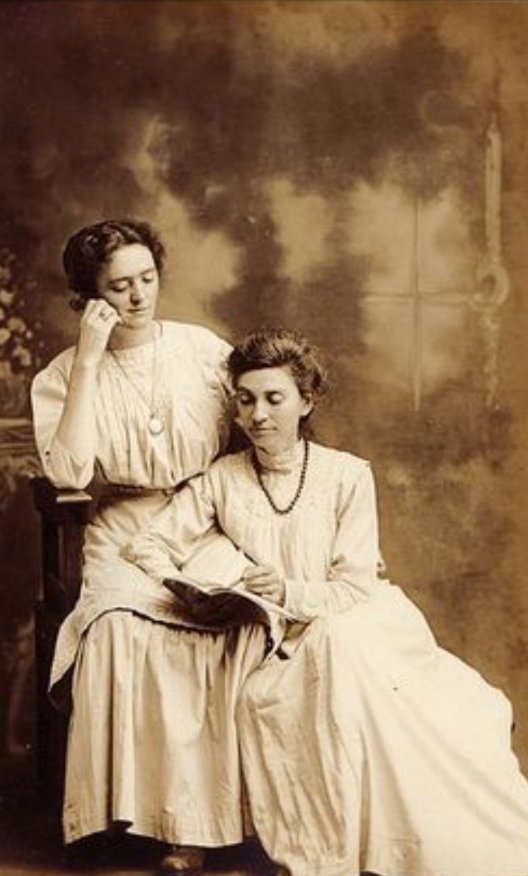
The Poetic Drama of Michael Field

Though perhaps better known for their poetry – Long Ago (1889), Sight and Song (1892) and Underneath the Bough (1893) to name a few – the Fields were large contributors to the world of fin de siecle poetic drama. An argument may even be made that they were one of the most important and prolific verse dramatists of their time.

Vadillo writes that:

“Reading the poetic dramas of ‘Michael Field’ … one is continuously astonished by the extravagant plots, the audacity of their verse, and the uncontained character of their plays … The breadth of history and scholarship is bewildering, with plays rooted formally and thematically in the traditions of Classical Greek, Latin, Medieval, Renaissance, and Romantic poetic drama.” [1]

Certainly, their coverage of European culture is vast, and the intellectual depth of each play is astounding to a modern audience. While the twenty-first century has lost its appetite for poetic drama and it is, as Vadillo says, seemingly “a dead genre” [2], the Fields remind us just how significant dramatic verse could be to an interested late nineteenth-century audience. In a time of shifting literary tastes and experimental form, the Fields attempt to assimilate this traditional format into the realm of modernist thought. In a way, it can be said that they attempted to use the ‘old’ to communicate the ‘new’ (putting “Old Wine in New Bottles“, to borrow a name of one of Edith Cooper’s unpublished plays from 1892). Their modernist voice was appropriating historical myth and literature through poetic drama.

A Timeline of Published Poetic Drama

The best known and first published entries of dramatic verse written by Michael Field are Callirrhoë (1884) and Fair Rosamund (1884) which recieved a positive reception. These dramas employed hellenism as a scholarly, respected discourse allowing them to subversively author notions of same-sex passions and pleasures. Immediately the poetic verse reminded readers of Swinburnian ballads and poems from twenty years earlier, which had also enjoyed hellenic subjects and revelled in mad, irrational Greeks. (This would come of no surprise later in their literary career, when Michael Field reveal that they were devotees of the work of Swinburne).

Kindly reception for the Fields’ early literary career

They also published The Father’s Tragedy (1885), William Rufus (1885) and Loyalty or Love? (1885) following that. Untiring, they continued to bring Brutus Ultor (1886) and Canute the Great (1887), with The Cup of Water (1887) squeezed out just after.

However, as the identity of the two women behind ‘Michael Field’ became more widely known, the Fields began to attract growing negative criticism. They did not back down in the face of scathing reviews and harsh remarks but the 1890s marked a more intense desire for the lyrical at the cost of the dramatic. As Vadillo puts it, the “decadent 1890s brought to this avante-garde poet a difficult battle: to make the genre matter again or disappear” [3]. Fewer and fewer readers were drifting towards Scottish kings and the dramatis personae of England’s eleventh-century royals found in the likes of Fair Rosamund and Loyalty or Love?. They were craving newer, fresher subjects.

‘The Race of Leaves’ as illustrated by Charles Ricketts. (1901 edition, Hacon & Ricketts, New York: John Lane)

So too then did the Fields’ tastes change a little. But this was not by bringing in modern history. The Tragic Mary (1890) was their last renaissance play before they moved further back in time to a more Roman-centric sphere, churning out a ‘Roman Trilogy’ of sorts – The World at Auction(1898), The Race of Leaves (1901) and Julia Domna (1903). For Bradley and Cooper, this meant revisiting their Homeric and Virgilian learning, but more importantly, revisiting the themes of their original debut Callirrhoë which celebrated a Grecian cult dedicated to Dionysus, the god of winemaking, madness and theatre among other practices. In this spirit of rebelliousness, the writings of the Fields took a noticeable change for the turn of the century.

Notably, they had to be careful in distributing this kind of content after the trails of Oscar Wilde, since Latin decadence as they were dabbling in was under attack and hefty scrutiny. But this did not stop them from re-conceptualising the genre of dramatic verse from this decadent angle. They also began to adopt the philological criticism of Friedrich Nietzsche. Nietzsche’s newly reissued The Birth of Tragedy (1886) philosophised the cultural binaries of the Apollonian and the Dionysian, which again allowed them to touch back on Callirrhoë and the mad Dionysus. In fact, the Fields even often referred to themselves as ‘maenads’ – female followers of Dionysus – in their private letters, playing with the concept of themselves as ‘mad women’.

Original German copy of Nietzsche’s ‘The Birth of Tragedy’, 1872

One of the things Nietzsche had considered which became equally apparent to them through their talks with close friend Bernard Berenson was the issue of giving historically-derived plays secular meaning. As Vadillo remarks, these “talks, which Cooper recorded in their diary, were important for Michael Field because they helped them articulate the problem they were dealing with in their verse dramas: how to make historical plays be about life, not history” [4]. As the tastes of the literary masses were changing, the direction of authors and their works had to change too. Everyday readers wanted historical material that was in some way relatable. The format had to adapt, and the Fields felt that Nietzsche understood this as they did.

The year 1890 was also the year that the papal apartments used by Pope Alexander VI, Rodrigo Borgia, were opened to the public for the first time since his death in 1503. The Fields had much to consider and write on this front. They published Borgia (1905) as a tribute to the new emerging information and resurfacing rumours surrounding the historical Borgia legacy.

The 1890s also brought Stephania, a Trialogue(1892), A Question of Memory (1893) and after a pause in literary inspiration, Attila, My Attila(1896). Despite their difficulties in finding motivation at the hands of turmoil in their personal and aesthetic lives, the Fields also managed to publish World At Auction (1898) alongside help from their friend Charles Ricketts over at the Vale Press, swiftly accompanied by Noontide Branches(1899) and Anna Ruina (1899) in the year after.

It was also during this turning of the century that Edith Cooper became curious about Catholicism and lost her father who died in 1899. His death allowed them to purchase a new residence. Then, thrusting forward into the new twentieth century, the Fields – mostly Edith Cooper to begin with – began to contemplate a conversion to Catholicism, though they would not become Roman Catholics until 1907.

After a tumultuous 1890s for themselves and their literary career, the Fields continued to suffer a somewhat waning legacy and they conversed with fewer friends. History has been rather unkind to the Fields, by this point regarding them as merely “pathetic literary hangers on” [5] to quote Emma Donoghue, their status as illustrious aesthetes dissolving. But still they wrote and still they published verse drama, bringing about a more cheerful Wild Honey from Various Thyme (1908) and Queen Mariamne (1908). This was followed by a constant string of verse drama all in the same year: Tragedy of Pardon (1911), Tristan de Léonois (1911), Dian (1911), The Accuser(1911) and The Messiah (1911).

Sadly, Edith Cooper had passed away as a result of cancer by 1913, with Katherine Bradley passing away shortly after. It was not until after their deaths that Ras Byzance (1918), Deirdre (1918) and finally In The Name of Time (1919) were published.

Of course, in the midst of all this verse drama there were various love poems written to one another, journal entries written, scrapbooks created, familial upheaval, continental journeys, poetry collections published, reviews written and other projects undertaken. The lives of Bradley and Cooper were busy ones and their words span more than simply the volumes of verse we have touched on here. The verse they wrote was in some ways a chronicling and forging of individual milestones marking passages and transformations in their own lives.


Footnotes

[1] Ana Parejo Vadillo, “‘The hot-house of decadent chronicle’: Michael Field, Nietzsche and the Dance of Modern Poetic Drama,” in Women: A Cultural Review 26, No. 3, (2015): 1.

[2] Vadillo, “’The hot-house of decadent chronicle’: Michael Field, Nietzsche and the Dance of Modern Poetic Drama,” in Women: A Cultural Review 26, 2.

[3] Vadillo, “‘The hot-house of decadent chronicle’: Michael Field, Nietzsche and the Dance of Modern Poetic Drama,” in Women: A Cultural Review 26, page 2.

[4] Vadillo, “‘The hot-house of decadent chronicle’: Michael Field, Nietzsche and the Dance of Modern Poetic Drama,” in Women: A Cultural Review 26, page 8.

[5] Emma Donoghue, “Introduction,” in We are Michael Field, (Absolute Press: Bath, 1998), 7.