
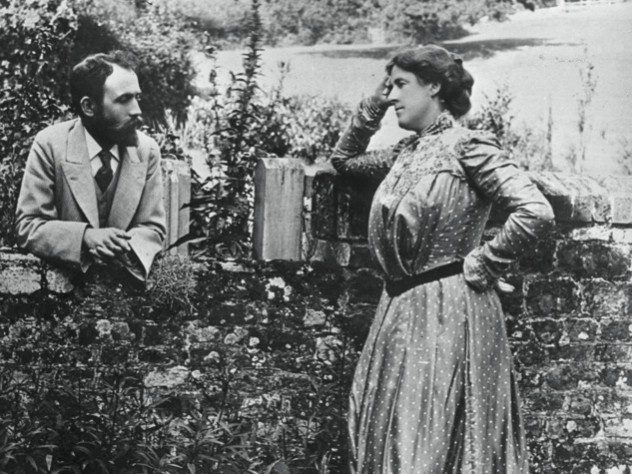
When Bradley and Cooper met Berenson they had already penned several volumes of poetry and drama. Berenson was a late nineteenth-century Jew apparently possessing somewhat of a feminized, maternal nature, notably sensitive and well kept. In his autobiography he even termed himself feminine and maternal in nature, declaring that he was drawn to falling in love as a means to be ‘absorbed’ by his female counterpart. Much of this image of Berenson was serviced by the prejudice against Jews: he was already deemed inherently effeminate and half-demonic. Perhaps this was why the Fields thought it humorous to attribute him more nicknames. Upon meeting them he was soon referred to as the “Faun”, even as “Dionysus” – an amusing oxymoron, Vicinus notes [1], when considering he was also “Doctorine” – all of which was well suited to his dark, curly hair, lovely hands and finely trimmed beard.

Bernard Berenson came to be a significant figure in the lives of Katherine Bradley and Edith Cooper. They offered to pay for his art history lessons and he flourished under their admiring, thoughtful reactions to his art theories. According to Vicinus, they “spent hours talking about life, aesthetics, and creativity. Bradley and Cooper were happily smitten with Berenson’s intelligence, beauty, and respect for them; he was the first man they had met who seemed to take their ideals seriously.”[2] Equipped with American candour, an alleged Slavic soul and Jewish intelligence, he was incredibly attractive to both women.
His androgynous ‘Faun’ nature also helped cultivate the rich gender fantasies of Bradley and Cooper. Often batting around masculine nicknames as a means of gender play, they welcomed the incorporation of a new erotic masculinity into their lesbian relationship and their literary works. Previously female subjectivity and distinctly lesbian homosexuality had been explored in their literature – Sappho in Long Ago, the kings and queens of Fair Rosamund and Callirhoe – but now there was Berenson, who, as Vicinus puts it, “championed Walter Pater’s aestheticism of pleasure, became both their muse, teaching them to see art more fully, and their beautiful faun, an art object that they partially possessed because they supported him financially and emotionally.” [3] Berenson was swiftly becoming an integral part of their literary inspiration and romantic motivation.
For Edith Cooper, the integration of Bernard Berenson into their world meant that she become the adolescent boy in the relationship. Though she had always enjoyed her “aunt’s loving poetic gaze” [4] as the youngest in the Field partnership, she was now also the subject of Berenson’s gaze. She began to model herself on Berenson a little, so that she could ‘masculinize’ herself more, attempting to differentiate herself from her aunt so that she could reach an androgynous boy-role of her own somewhere between her biological identity as a woman and her literary identity as a man.
This meant that Katherine Bradley assumed a more maternal, guiding role in this three-way association. For Bradley, Berenson was an intellectual mirror and catalyst, believing that his ideas nourished her art. Berenson made her feel grounded in the scholarly realm. He gave her masculine intelligence merit and validation. More than a mere muse, he made her able to participate as a full citizen in a world so discriminatory against women and less respectful towards older, wiser, women in particular.
This was until Mary Costelloe began an affair with Berenson in the summer of 1891. At first the Fields considered Costelloe no threat, but when the Fields went with Berenson and Costelloe to Paris to study art in 1892, their three-way bond began to deteriorate. Costolloe instead began winning Berenson’s affections rather than his art lessons with the Fields, and Cooper’s diary entries turned sour, expressing her jealous “burning stares” after Berenson and Costelloe and her “dull rage” [5] that took over in the face of his revolving favour. Sickened by the way in which Berenson caused them to question themselves and their shared identity of ‘Michael Field’ by becoming distant, things began to change. For Bradley, she realised that Berenson had undermined the foundation of her creative being, her lesbian love, betraying the Fields for Costelloe. Without his love, this impacted her power to write. For Cooper, the distance of Berenson rattled her artistic philosophies. Without his presence in her life, she felt that she lacked the ability to give ‘life’ to her art, her poetry. Berenson began to prefer his role of expert – as art critic, becoming an art connoisseur in Italian renaissance paintings with Costelloe beside him – over his former role as art consumer, abandoning his art lessons with the Fields. He sided with the critic over the artist, while ‘Michael Field’ had always had his allegiance to art and the artist over the critic. Here, then, was where their three-way union crumbled. Worse, Bradley and Cooper began to feel divided in their own feelings towards art. Thus the identity of Michael Field began to suffer. A title which once drew them together became difficult to navigate as a joint force. Cooper’s aesthetic position began to change, influenced by her new feelings regarding the shift in Berenson’s absence. With Berenson gone, things grew dark for ‘Michael Field’.
However, Vicinus writes that:
“The two women, divided by an unrequited passion, tried to reunite via the written word. The diary became their preferred form of reconciliation. They had always written their poems separately and then edited each other’s work; now their diary entries reveal an ongoing dialogue of love, jealousy and division. Cooper’s aesthetic position, which combined the personal and the artistic, required an audience. She knew she had Bradley’s attention, whatever happened to Berenson. Bradley’s sympathy and pain fuelled Cooper’s unrequited passion, helping her to transform it into art. The two poets were locked in a symbiotic artistic relationship, in which Bradley encouraged and feared Cooper’s new feelings and new writing.” [6]
Therefore the identity of ‘Michael Field’ soldiered on, though never quite the same. It was not reinvented so much as it was altered in parts: Cooper and Bradley used their diary to carry on communicating their fluctuating feelings towards art which evolved over time. Cooper’s lyric output changed character, growing less sensuous but more serious and philosophically daring, as we see in Underneath the Bough. Masculinity was no longer something that they could masquerade in, a mask they could assume whenever they desired, but rather something complicated, something desired as a goal but ever distant for Cooper. Bradley did not quite feel the same, still connected to her masculinity through her part in the title of ‘Michael Field’. Katherine Bradley was, after all, the masculine ‘Michael’, as Edith Cooper was the reflective ‘Field’ (though more often nicknamed ‘Henry’ [7]). But this concept of masculinity troubled and continued to divide them. Masculinity was no longer a part of Cooper’s identity without Berenson around, it seemed, while for Bradley it always had been, for masculinity could be found in art, which they themselves had already represented. Masculinity was fracturing their literary persona.
They rebuilt their shared identity, of course, but it took much effort. On Cooper’s birthday in 1897 Bradley wrote her ‘The Art of Love’. The poem, and Bradley in turn, argues that their love is eternal because it originates in their shared art which comes from their poetic energy and their literary work. Love was not in competition with art, instead it came from it; was given life by it. As Vicinus summarises it, the poem “confesses that their oneness rests in being Michael Field; from that identity springs their lesbian love.” [8] After that Cooper began to side more with Bradley again in her attitudes to art. Bradley had won her back, but Cooper had lost much of her creative energy, writing little for a time. Bradley remained unfaltering, however, in her belief in ‘Michael Field’. Some time after the marriage of Mary Costelloe and Bernard Berenson she wrote, in comparing her and Cooper to the well-known Elizabeth and Robert Browning: “those two poets, man and wife, wrote alone; each wrote, but did not bless or quicken another at their work; we are closer married“. [9]
Both poets believed in themselves as ‘Michael Field’ and thus were dedicated to the name. But while Cooper separated her love and love of art from their shared identity, Bradley instead channelled these emotions into Michael Field. It was this that had caused a divergence, and this that made it more difficult for Cooper to accept the loss of Berenson as an early part of this shared identity, pining for him even after he married Costelloe. Bradley had recovered quicker, only ever needing Cooper as her foundation for literary and personal existence, having used Berenson as a mirror rather than another soulmate. This had not been the case for Cooper.
Caught in a wave of radical aesthetic and political change, the fin de sièclehad been a turbulent and transformative time for Katherine Bradley and Edith Cooper, and more so for the identity behind ‘Michael Field’.
Bernard Berenson remained, to some extent, in their hearts, but had become less a collaborative companion and more a distant friend by the end of the nineteenth century.
Footnotes
[1] See Martha Vicinus, “Faun Love: Michael Field and Bernard Berenson,” in Women’s History Review 18, (November 2009): No. 5: 754.
[2] Vicinus, “”Sister Souls”: Bernard Berenson and Michael Field (Katherine Bradley and Edith Cooper),” in Nineteenth-Century Literature 60, No. 3 (2005): 329.
[3] Vicinus, “Faun Love: Michael Field and Bernard Berenson,” in Women’s History Review 18, 755.
[4] Vicinus, “Faun Love: Michael Field and Bernard Berenson,” in Women’s History Review 18, 755.
[5] Vicinus, “Faun Love: Michael Field and Bernard Berenson,” in Women’s History Review 18, 756.
[6] Vicinus, “Faun Love: Michael Field and Bernard Berenson,” in Women’s History Review 18, 757.
[7] Jill R. Ehnenn, Notes of “”Our brains struck fire each from each”: Disidentification, Difference, and Desire in the Collaborative Aesthetics of Michael Field,” in Economies of Desire at the Victorian Fin de Siècle: Libidinal Lives, edited by Jane Ford, Kim Edwards Keats and Patricia Pulham, (Routledge: London, 2015), 201.
[8] Vicinus, “Faun Love: Michael Field and Bernard Berenson,” in Women’s History Review 18, 761.
[9] Bette Lynn London, “”Something Obscurely Repellent”: The Resistance to Double Writing,” in Writing Double: Women’s Literary Partnerships, (Cornell University Press: Cornell, 1999), 67.


 Exploring Michael Field